
Starting cut flowers from seed ignites the flower gardener before the season even starts when the snow is still fresh on the ground. The blizzard is outdoors, the gardener is gardening indoors with seed starting mix, cell trays, and grow lights, just awaiting the warmer seasons of spring and summer.
With growing flowers from seed for bouquets, folks always ask how I do it. How do I end up growing all those beautiful blooms that are shining in the vase in their one hand as they build a conversation with the girl that grew them?
It is not easy, but when taken step by step, it is possible for even someone who typically has a black thumb. Maybe not a black thumb, but more someone who lost their green thumb or never even knew they had a green thumb to grow beautiful gardens.

Calculate Seed Starting Date
This is imperative to know your seed starting dates. It doesn’t have to be perfect, but it does need to make sense. One is not going to be starting zinnias in November for a summer harvest. Lisianthus started in December or January, absolutely (unfortunately!!!).

When is Your Average Last Spring Frost?
This is the usual starting point to calculating a seed starting date. Do a quick Google Search with your zip code and you should be able to find some resources for this.
As for me, my average last spring frost ranges from May 10 to May 20. It’s never the same every year, so when it comes to planting season, just do a double check to see what the temperatures are that tentative week.
Is Memorial Day the Average Last Spring Frost?
Uhh, no. Well . . . maybe for some.
Gardening friends ask all the time when to plant their gardens. Other friends in Pennsylvania may share it is best to wait to plant at Memorial Day. Is this true?
If it works for you, keep it up. If you are new to gardening or want to try to plant a bit earlier, take the time to do your research. You may be able to start planting sooner rather than later. It all depends where you are located, your micro-climate, current weather predictions, and what you are planting.
In my neck of the woods, May 31st is usually one to two weeks behind planting schedule for some garden plants. It is okay and by no means wrong to plant a garden Memorial Day Weekend, but I have so much to plant, I need time before and time afterwards to get this done.
Just keep this in mind because if you plant seeds or transplants after Memorial Day, for a lot of garden plants, this is perfectly fine and acceptable. It just takes knowing how long that plant will take to grow from seed or transplant to harvest.
Why Calculate the Average Last Frost?
If we are looking for the tentative last spring frost, why is it so important to calculate and what will it help us calculate? Once you know your tentative planting date for transplants, you can calculate when to start your seeds indoors. For example, I treat May 15 as my warm-season annual transplant date. When a seed packet instructs me to start my seeds six weeks before the average last frost, I start my seeds six weeks before May 15. That way my plants are ready to be transplanted whenever the garden is ready to go.

When to Start Cut Flower Seeds Indoors?
Cut flower seed starting dates depend on when you want to plant them and when you want them in bloom. I keep my garden rather simple in having a mid-spring planting date for cool-hardy annuals, which is April 15, as well as a late-spring planting date for warm-season annuals, which is May 15. These dates may differ, all depending on where you are located.
Cut flowers from seed vary in how long they take to get a head start indoors. Every seed packet will tell the grower how long they need.
Can Cut Flowers Overwinter for Early Blooms?
Some cut flowers can overwinter for earlier blooms. Cool hardy annuals and perennials do the best. Sometimes I have petunias or sunflowers surviving the winter, but as volunteers, nothing ever intentional.
Plan to plant cool hardy transplants in late-August or mid-September when the soil is still warm. The rule of thumb is to figure out your average first fall frost date. As an example, mine is the first week of October. The fall-planted cut flowers need to be transplanted into the soil 6 to 8 weeks before this tentative date to allow time for the plant to root into the soil. Think end of August or mid-September for my fall transplanting date.
For the transplants to be ready to go, they need to be started weeks in advance based on the information on their seed packet. For example, if my average first fall frost is October 3, then my transplanting date would be August 22 (six weeks ahead), leaving me to start my fall snapdragon seeds June 13 (ten weeks ahead).
Sowing Flowers from Seed Indoors
Cut flower seeds come in an array of seed sizes. Snapdragons are smaller than if a pencil made a dot on a piece of paper. Marigolds are elongated about ½” long. Scabiosa and cosmos seeds have such a unique shape to them.
I do try to start everything in the standard 72-cell tray. Smaller seeds may be started in smaller cells, and larger seeds may do better in a larger-cell tray.
Keep just 1, 2, or 3 seeds per cell. For the smaller seeds, try using a toothpick dipped in saliva to make it easier to have only one or two seeds per cell. For larger seeds, I make an indent to place the seed in.

Pre-Moisten the Soil
To start, pre-moisten the soil medium. I use the all-purpose blend from Lambert, but any seed starting mix will work.
Place the soil medium into the plug cells. Soil media should not be compacted, but it should fill each cell to the top.
Add the Seeds
Open a packet of cut flower seeds. Dump a small pile of these seeds into your non-dominate hand. Then use your dominant hand to pinch and pick up a few seeds at a time.
Place seeds in different cells. Some flower seeds will need to be covered while others will need light to germinate.
Move to Grow Lights
Place the seed tray underneath a grow light. Heat mats are optional, but in a cooler basement or area may be imperative for warm season annuals. Cool-hardy flowers from seed will need less heat to germinate well and will prefer cooler temperatures.
Use a humidity dome, if necessary, until everything is at the true leaf stage.

Typical Germination
Seeds will typically germinate after 7-14 days at warmer temperatures. See seed packets for more information on each variety of flowers.
How to Care for Flower Seedlings Indoors
Seed starting doesn’t just start and stop with placing the seeds into the soil medium. Nope, you need to have the energy and the time to continue to take care of them, so they are healthy when they move onto the transplanting stage.

Watering
Keep watering every day, or when soil dries. Don’t wait until the soil dries out completely and the seedlings begin to wilt or die.
But also, be careful with how much water you use. If the plug trays are sitting in water and the soil media cannot absorb anymore, get those baby plants out of that water, ASAP!
It’s important to find the right consistency for watering and what works for you. Some years, I am all about bottom watering, until I water too much. Other years, I use a sprayer on the mist selection, so I don’t end up over watering. The downfall is sometimes I’m not watering enough.
Lately, I’ve found bottom watering works best when seedlings are still babies, before their true leaves tart. Afterwards, I like using the mist selection on my backpack sprayer.
Fertilizing
Cut flower plants will need fed throughout the indoor growing season. Start with half-strength fertilizer until seedlings have their true leaves. Then, fertilize at full strength about once a week until plants are three inches tall.
Plants love using nutrients from fish fertilizer. Be careful because this stuff does stink, so if you are growing seedlings in a kitchen, living room, or any everyday living space, you might want to opt for a different fertilizer.
Another great fertilizer is Biotone or Gardentone from Espoma. These fertilizers use organic, natural materials. It does not emit the same level of smell like fish fertilizer.
Thin Seedlings
Some cells end up with three seeds while other cells end up with none! Oops!!! Some have way too many plants for cell. It happens. The end goal is to have one plant per cell.
I tend to wait until the seedlings have reached their true leaf stage where seedlings have miniature leaves that resemble the leaves of a fully grown adult cut flower. I want them to have a good root system, but also before the roots are about fully established.

Thinning Flowers: Move into an Empty Cell
When some plug cells do not have a flower germinated, I take some from another cell that has extras to fill up the empty ones. If 6 cells did not germinate, but 12 cells germinated 2 healthy seeds each, I’ll take those extras and move them to the empty cells.
The young flowers from seed should have a strong root system with some soil medium remaining around the root. Don’t bother with cleaning that soil off.
Use a pencil or popsicle stick to create a hole in a new cell large enough for the cut flower seedling. If the seedling has plenty of soil around its roots, I create a larger hole. If the seedling is rather small and is essentially just roots with a green stem and few green leaves, I make a small hole, so the seedlings don’t drop down into the hole too far.
Thinning Flowers: Cut and Discard
For the rest of the extra cut flowers, let’s go over the conventional method to thinning snapdragons. The goal of this method is to help the single, remaining flower to flourish in its cell, alone, with all the room to itself.
Choose the cut flower that you would like to keep. You can choose the plant that is the center in the tray, the plant that is the healthiest, or use both of these factors in choosing one.
Keep this chosen flower, while all the spare flowers are in the tray, cut them at the base and discard them. This keeps the main flower undisturbed, while the extra ones are out of the way.
Thinning Cut Flowers: Pull and Transplant
I hate spending all this money on seeds, to start two or three seeds in each cell to make sure I get one, to then only discard the extra ones. Pulling and transplanting is the method I use most of the time because I like to give all my plants a shot, even if they’re the secondary ones. I pull the seedlings at the base, include a good root system, and then transplant them into another plug tray, outdoors with the best of luck, or in some other container.
First, grasp the bottom of the flower stem. Pull gently out of the soil. Sometimes if seedlings are so close, I will pull four or five out at a time. It seems that this does better for getting all the roots. This is not the case if one plant is along the left edge and another is along the right edge. Pull them out individually.
Set off to the side to transplant into an empty cell with pre-moistened soil medium.
Place the seedling into the hole until the bottom leaf meets the level of the soil medium. Press the seed starting medium to secure the seedling in place.
Create Beauty
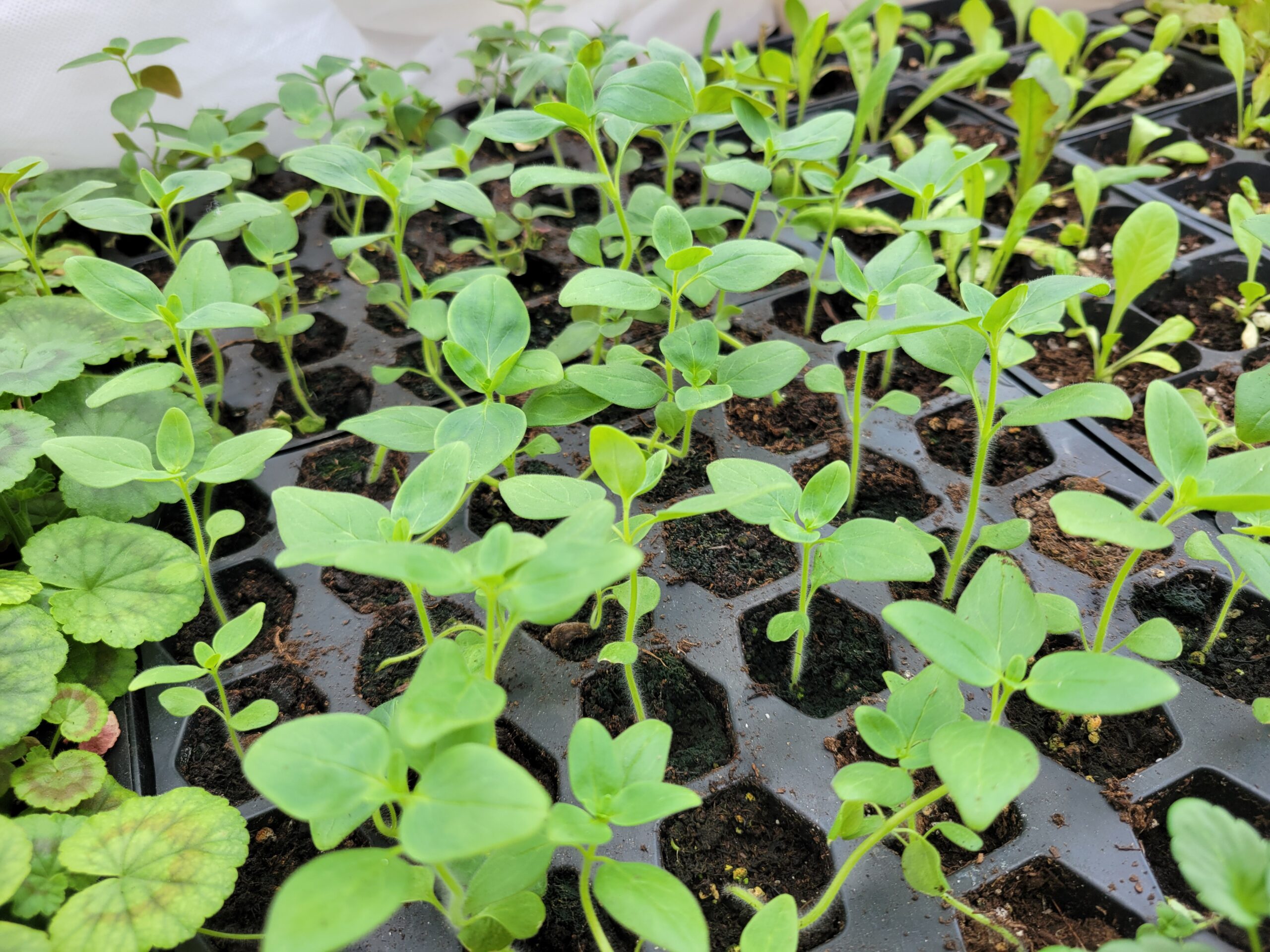
The cut flowers in full bloom are what we seek when we are starting our flower seeds indoors, but there is beauty in having a basement full of life of various flowers from seed. Cool hardy. Warm season. Perennials. Snapdragons and sweet William with multiple true leaves, while starting the marigolds and cosmos from seed.
Every step brings more beauty and creativity to the process. From daydreaming about what to plant and where to seed starting and planting outdoors.


Leave a Reply