
Cosmos (Cosmos bipinnatus) begin as an easy to grow seed, one of the easiest. It can be direct sown into the soil or started indoors and later transplanted. The seeds come from the center of the plant; a seed in an elongated shape that shapes into a small point near the one end.
Cosmos is a flower that the seed catalogs introduced me too. It has such a strange name for such a beautiful flower. I don’t believe the seed packets at large store chains really show off their beauty.
The first variety I tried was Double Dutch Rose Cosmos, a heirloom variety from Baker Creek. By far, still my most favorite variety of cosmos to date. Just trying one variety will lead you into wanting to grow them all.
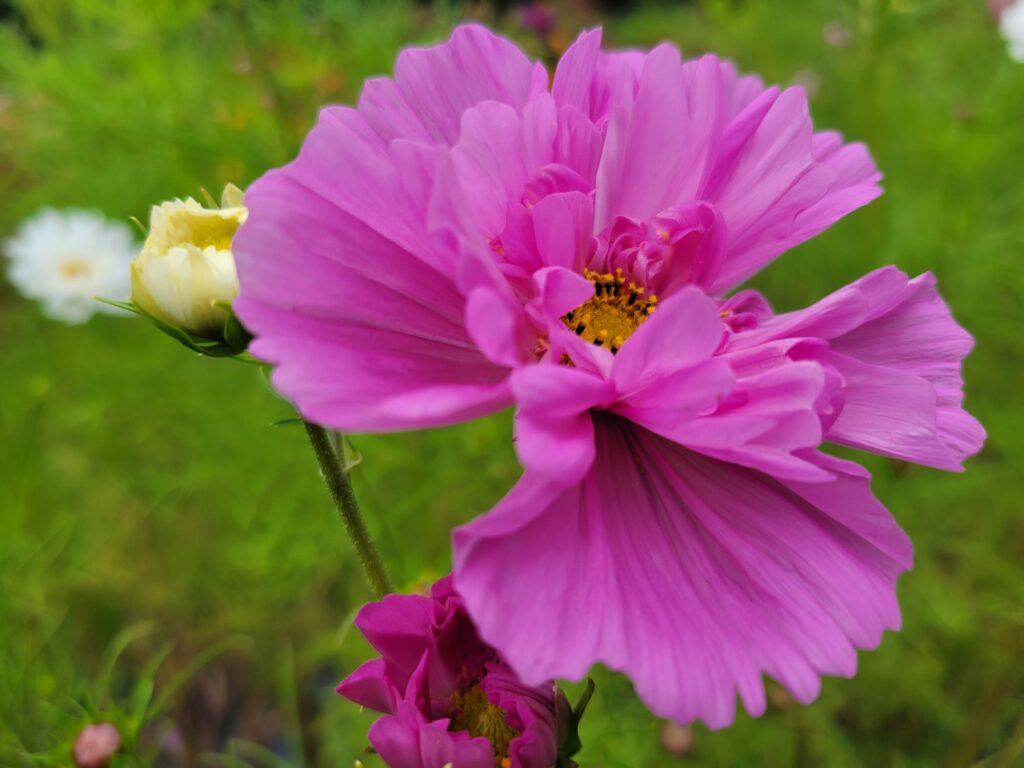
Cosmos can be found in pinks, whites, burgundies, apricots, oranges, and yellows. They can bloom in single petals, seashell shapes, or double petals with hundreds of packed together petals. Whichever variety, any and all cosmos flower with bloom beautifully in your garden.

Growing Cosmos in Nine Easy Steps
- Select Seed Varieties
- Calculate Seed Starting Date
- Sow Seeds Indoors
- Seedling Care
- Thin Seedlings
- Hardening Off
- Transplant in the Garden
- Gardening Care
- Harvest the Flower
Why Grow Your Own?
Cosmos are so easy to direct sow that buying any a garden center seems ridiculous. A packet of seeds ranges from $2.00 to $5.00, depending on the company and the variety. These packets, though, provide numerous plants, more than maybe one or two you could buy at a garden center.
I also find that most of the greenhouses I buy flowers from, they do not have cosmos plants. I think they know they just do best from seed.
For bouquets, their blooms are such a showcase. Cosmos have a classic flower aesthetic with a disk shape in the center and multiple petals surrounding that disk. More importantly, cosmos come in all sorts of color schemes. I tend to choose the pinks, apricots, and whites, but cosmos come in oranges, yellows, and burgundys as well.

Selecting Seeds and Varieties
Double Dutch Rose
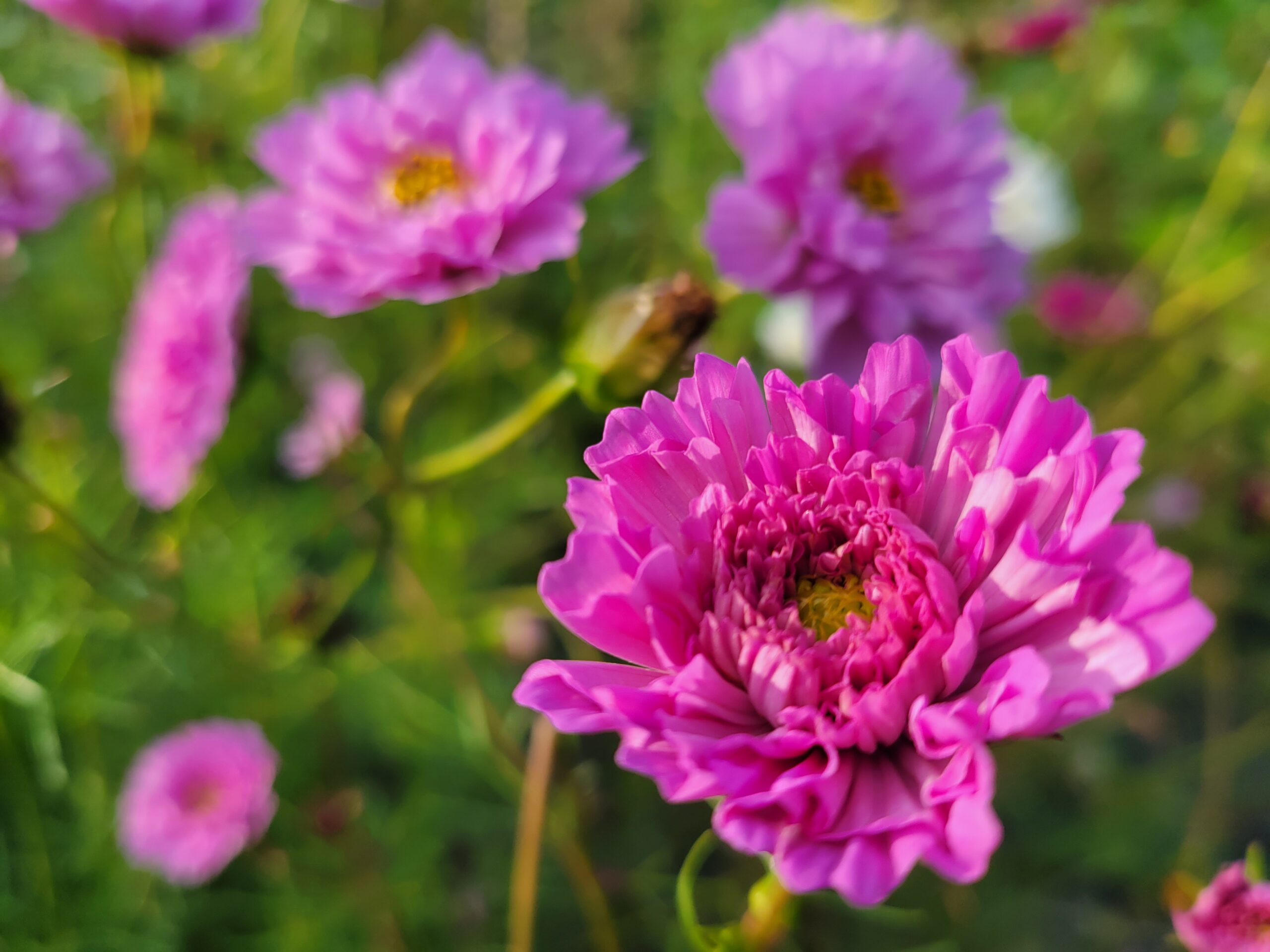
Heirloom flowers have something about them. Double Dutch Rose is an heirloom cosmos with rosy pink petals. The bloom heads are loaded with hundreds, producing such a beautiful flower. Plants may reach 48-inches in height.

Double Click
If you love Double Dutch Rose, any Double Click variety is a packet of additional seeds you need to buy. Multiple shades of white, pinks, purples, and bi-colors.
Flower heads are 2-3-inches wide with fully-double, sometimes semi-double, blooms. Plants may reach between 42-46-inches tall.

Apricot
Apricotta and Apricot Lemonade cosmos seeds are in shades of apricot, salmon, and peach. Single petals with a gradient of colors.
Flowers are 2-3-inches wide. Plants may reach to 4-feet in height.
Rubenza
Darker pink petals with vertical lines on the petals. Shades of this flower varies, but ranges from a darker ruby red to a pale antique shade of a dark pink. Beautiful in bouquets!
Single petals are on flowers 2-3 inches wide. Plants may reach to 4-feet in height.
Versailles
Versailles cosmos comes in a variety of colors from the whites and pinks to the reds and darker pinks. Stems grow to 40-48” with blooms of 2 ½-inches.
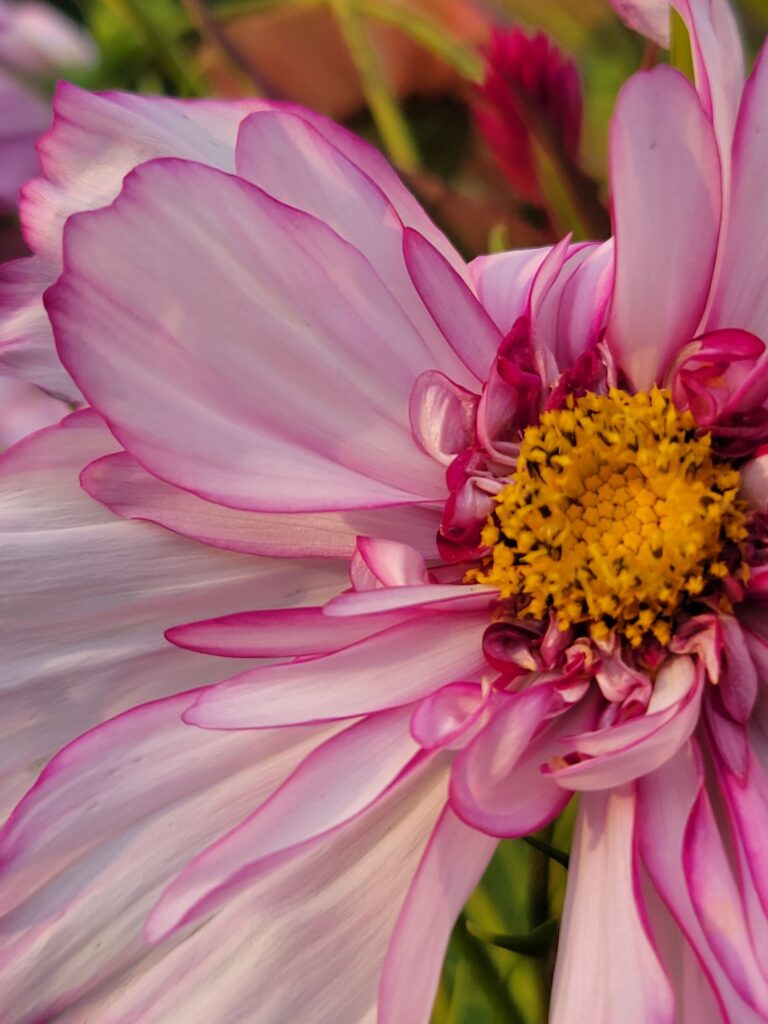
Versailles Flush Cosmos produces stems with 2 ½-inch bloom with white petals streaked with a pale pink. My fav! A great cut flower!
Sea Shells
These cosmos have the most unique shape! The petals curl-in the whole way to form a shell shape of a petal. They come in the normal range of flowers: pinks and whites.

Cosmic Red, Yellow, Orange
A dwarf cosmos plant that is great for bedding and landscape, growing to a height of 1-2 feet. Reminds me of marigolds with shades of reds, yellows, and oranges. These cosmos have centers with small yellow with colorful petals surrounding them.
Xanthos
Xanthos cosmos are a great yellow variety, but beware, they are shorter than the typical cosmos. A pale yellow cosmos great for flowers beds and landscape.
Learn More About Growing Cut Flowers
Calculate Seed Starting Date

When is Your Average Last Spring Frost?
This is the usual starting point to calculating a seed starting date. Do a quick Google Search with your zip code and you should be able to find some resources for this.
As for me, my average last spring frost ranges from May 10 to May 20. It’s never the same every year, so when it comes to planting season, just do a double check to see what the temperatures are that tentative week.
Why Calculate the Average Last Frost?
If we are looking for the tentative last spring frost, why is it so important to calculate and what will it help us calculate?
Once you know your tentative planting date for transplants, you can calculate when to start your seeds indoors. For example, I treat May 15 as my warm-season annual transplant date. When a seed packet instructs me to start my seeds six weeks before the average last frost, I start my seeds six weeks before May 15. That way my plants are ready to be transplanted whenever the garden is ready to go.
When to Start Cosmos Seeds Indoors?
Cosmos seed starting date depends on when you want to plant them and when you want them in bloom. With cosmos being warm season flowers, I wait until my late-spring planting date of May 15, as long as the average last frost is over.
Cosmos take between 5-7 weeks to get a head start indoors, if you want a healthy plant ready to go. To have transplants ready by mid-May, I subtract 7 weeks from that date, which is March 17.
Sowing Cosmos Seeds Indoors
Cosmos seeds are the easiest seeds to handle and to identify. You will not be mixing them up with another seed. I use my standard 72-cell tray to start cosmos. The seeds are large enough to pick up with your fingers, so a toothpick is not necessary.
To start, pre-moisten soil media. I use the all-purpose blend from Lambert, but any seed starting mix will work. If you would like, you could add organic pelletized fertilizer to mix in with the soil medium. I like Espoma brand for this, using either Biotone or GardenTone.
Place the soil medium into the plug cells. Soil media should not be compacted, but it should fill each cell to the top. Use a pencil or popsicle stick to create a small hole ¼” deep.
Open a packet of cosmos seeds. Dump some seeds into your non-dominate hand. Use your dominant hand to pick up 1-3 seeds at a time. Add approximately 2 seeds per cell.
Lightly cover seeds. Place the seed tray underneath a grow light. Heat mats are optional but recommended with warm season annuals. I do use humidity domes until everything is at the true leaf stage; nevertheless, this is due to my basement staying drier than other environments due to the dehumidifier.
Seeds will typically germinate after 7-10 days at 75-80°F, according to Johnny’s Select Seeds.
Cosmos Seed Information
| Start Indoors | 5-7 weeks before last spring frost |
| Last Spring Frost | May 15 |
| Seed Starting Date | March 17 |
| Germination | 7-10 days |
| Days to Maturity | 90-110 days |
Seedling Care

Watering Seedlings
Keep watering every day, or when soil dries. Don’t wait until the soil dries out completely and the seedlings begin to wilt or die.
But also, be careful with how much water you use. If the plug trays are sitting in water and the soil media cannot absorb anymore, get those baby plants out of that water, ASAP!
It’s important to find the right consistency for watering and what works for you. Some years, I am all about bottom watering, until I water too much. Other years, I use a sprayer on the mist selection, so I don’t end up over watering. The downfall is sometimes I’m not watering enough.
Lately, I’ve found bottom watering works best when seedlings are still babies, before their true leaves tart. Afterwards, I like using the mist selection on my backpack sprayer.
Fertilizing Seedlings
Cosmos plants will still need fed throughout the indoor growing season. Start with half-strength fertilizer until seedlings have their true leaves. Then, fertilize at full strength about once a week until plants are three inches tall.
Plants love using nutrients from fish fertilizer. Be careful because this stuff does stink, so if you are growing seedlings in a kitchen, living room, or any everyday living space, you might want to opt for a different fertilizer.
Another great fertilizer is Biotone or Gardentone from Espoma. These fertilizers use organic, natural materials. It does not emit the same level of smell like fish fertilizer.
Thin Seedlings
With adding 1-3 seeds per cell, some end up with just one seed, while other cells end up with two or three. That’s way too many per cell. But the goal is to have at least one plant germinating per cell.
Some cells may have no cosmos, so, some seedlings will need to be pulled and transplanted there.
I wait to thin seedlings until they have reached their true leaf stage. Seedlings should have miniature leaves that resemble the leaves of a fully grown adult cosmos.

Three Options for Thinning Seedlings
- Move Seedlings into an Empty Cell
- Cut and Discard Extra Seedlings
- Pull and Transplant into a New Tray
Read More with How to Start Cut Flowers from Seed
Hardening Off Cosmos
This is a phase that some gardeners skip, while other gardeners never go without doing this. I’m a bit between on this matter, between the avid gardener and the lazy one.
To get transplants acclimated to the outdoors, gardeners don’t want to give them a shock. Let’s go from a heated, sun-filled greenhouse to directly into the ground. Or let’s go from thriving in a warm basement under 14-hour long grow lights to outdoors with temperature fluctuations and different levels of sun throughout one day.
I do something a bit untraditional, but it has worked for me. I start my seeds all in my basement under grow lights. Some of the more sensitive plants will start upstairs where it stays a bit warmer and I can keep a better eye on their progress. However, I never take these plants directly from their grow stands to the planting stage.
Moving Cosmos to an Unheated Greenhouse
After starting indoors, I will gather up the cell trays that have “teenager plants,” plants that are no longer seedlings, but are not ready for the garden either. I take them to my unheated greenhouse with old, reused windows and a polycarbonate 6mm roof, place them on the tables in there, and so begins taking care of plants in the basement and in the greenhouse.
Here, the plants start to become accumulated into the Pennsylvania sunshine, which for the most part is accompanied by clouds, or completely taken over. The plants begin to become used to natural lighting.
Because I don’t keep the greenhouse at very warm temperatures, the greenhouse usually stays between 5 and 10 degrees warmer than the outdoor temperatures. Although my greenhouse could function with a heater, I choose to keep it unheated. Some nights when temperatures are to be lower, I use frost cloths over the plants to keep them warmer. I’m diligent in keeping an eye on the temperature outside and inside the greenhouse, so this method has always worked for me.

Be Careful with Temperatures
Another note, I do not move cosmos out to my unheated greenhouse until the average temperatures are above 35-degrees Fahrenheit, even during the night hours. That’s when I feel that it is safe to move the cosmos plants.
If the cosmos are enjoying life in the greenhouse and we have a surprisingly warm day with full sun, it may be where I open a few windows or leave the door open, so the greenhouse temperatures stay cooler.
With mid-spring weather jumping between cooler temperatures and about mid-summer temperatures, I do try to be vigilant in monitoring the greenhouse temperature. When its mid- to late-spring, sometimes the temperatures in the greenhouse escalate to 80’s and 90’s, where some plants would roast. Do try to be careful.
Transplant in the Garden
The month of May is full speed ahead for the planting season. After waiting for the last average frost to pass, gardeners are out there planting their warm-season annuals of flowers and vegetables. For my growing season, May 15, approximately, is my time to plant my warm-season garden. Cosmos, it’s their time!
Preparing the Soil
I swear every gardener prepares their soil differently. Do you have a rototiller? Do you have a tractor with a rototiller? Do you want to use a no-till method? Do you use a broad fork? Do you skip the in-ground, natural soil and opt for raised beds? I don’t think there’s a one-size-fits-all method of preparing the soil.
Feeding the Soil
For some, they will plan to use solely liquid fertilizer. I love using liquid fertilizers, especially Espoma products or fish fertilizers. However, when planting, I want my plants’ roots to have food as soon as they need it. I’ll use granular fertilizer from Espoma mixed in with my natural soil. I do this either before I lay the landscape fabric down, or individually with each plant.
However, I personally stray away from conventional fertilizer, such as 10-10-10. This is because it doesn’t work for me. It works when my husband applies it, but with me, I tend to burn the plants.
Uhh, whoops. So, I stick with using organic fertilizers that can be mixed into the soil and there’s not that great risk of burning the roots.
Another option to feed your soil is using compost. If you are applying this, use only a layer of 2 inches for the beds. Do not plant in hot compost that is more than that small layer or else it will have too much moisture in the ground.
If you would like, do both. Add a layer of compost where you plan to plant your cosmos, then sprinkle a granular organic fertilizer, and during the season use a liquid fertilizer.
Using Landscape Fabric
When planting cosmos, out of everything to prep, plan what to use to prevent weeds. Don’t wait until you have weeds overtaking your posies.
When using 6’ wide landscape fabric, leave the 1’ wide on the left end and 1’ wide on the right end for walkways, and leave 4’ wide of space for burning holes for your golds in the center of the landscape fabric. The walkway part will overlap with another 1’ walkway from another piece of landscape fabric, giving you a 2’ walkway.
For the spacing of the plants, burn holes 9-12” apart. This can be done all in straight rows or in a diagonal pattern.
Another option is to use landscape fabric 3’ wide in the walkways, while the planting bed will be 3-4’ wide planting beds. Do your best in keeping up with weeding.

Tips on Planting Cosmos
- Make sure to grab the transplant with all its roots
- Root system should be sturdy and be able to keep all the potting mix
- Transplants should be large enough with a few sets of leaves
- Plant in well-draining soil for springtime
- Space 9-12 inches apart
- Cosmos prefer warmer temperatures
Direct Seeding
If you love cosmos, but do not have seed starting supplies for the indoors, direct sowing them is the easiest root to take! Lay out and secure your landscape fabric, push a seed or two into the soft soil about ½” deep, and make sure it is covered. So easy!
I end up always direct sowing my cosmos as cut flowers. I think it would be neat to start dwarf cosmos as bedding flowers indoors. Find your preference and grow some beautiful blooms!
Gardening Care
As satisfying as it feels to have everything planted in the ground, ready for God’s Work to take over, our work isn’t quite over. It’s a balancing act between letting nature handle itself and making sure we are good stewards to the land. The bulk of the work is done with planting season, but let’s continue with the growing season.
Pinching the Stem
I always felt that this step breaks a beginner gardener’s heart. To take a pair of snips and cut the top of our growing plants.
But, why? Why take the top of a healthy plant?
When we do this, it encourages the plant to begin branching. So, any plant that will produce more blooms will benefit from this step, including our cosmos.
For a few weeks, cosmos will acclimate to their new outdoors environments and begin to grow vigorously. Once, cosmos are about six-inches tall, cut the top of the plant, right above a node and a set of leaves. You should leave about three to four sets of leaves on the plant.
Watering
For some gardeners, they put irrigation into place to make their lives easier with watering. For the past few years, we have gotten droughts throughout the summer with no rain for weeks. Maybe it should be the time I add irrigation to our garden, but for now, we have hoses that reach the garden to water during the no rain seasons.
I find there’s a debate about when the best time to water the garden is. Some gardeners only water in the morning because it is the best time. The plants are waking up with the sunlight and will soak up the water. Not every gardener is at home during the mornings, so I find evening watering works as well. Some may go into the ground versus the plant using it, but it sure is a lot better than not watering at all during a drought season.
Fertilizing
I think this all depends on different factors. Yes, make sure plants are fed. But, just maybe, you use some regenerative garden techniques, and the soil is healthy and feeds itself. Or maybe you used a good amount of compost and fertilizer when you transplanted and see the plants are doing well.
For me, I keep a 4-gallon backpack sprayer specifically for organic fertilizer, either Espoma or Alaskan Fish Fertilizer. I’ll use this liquid fertilizer on my plants throughout the season.
Pest Control
Where there is food, they will come. Beatles, bugs, little crawly things that you don’t know what they are. They’re coming for your garden and your cosmos.
We spray Captain Jack’s Neem Oil in the whole garden every two weeks, or as necessary. Although it must be reapplied, it works to keep the unwanted bugs away.
Learn More About Growing Cut Flowers in the Garden
Harvesting Cosmos
Cosmos offer a little leeway for the right time to be harvested. It is best to harvest cosmos when flowers are past the bud stage but before they are fully open; they will last longer in the vase. However, feel free to harvest flowers when they are fully open but before the petals begin to fall; they may not last as long in the vase, but they sure will be beautiful!

Supplies for Cutting Flowers
- Flower Snips
- Flower Bucket, filled with clean water
- Rubber Bands
When to Harvest Cosmos
Harvest in cooler temperatures. Some flower gardeners harvest first thing in the morning. I like to harvest in the evenings when it feels like everything is slowing down on the homestead, but early enough the nighttime mosquitos are not biting me!
How to Harvest Stems
Cut the stem above a node and/or a set of leaves near the bottom of the stem. Once you have a handful, place the stems in a bucket of clean water. If you would like, keep them together with a rubber band around the stems. Take the flowers indoors to rest before arranging them in bouquets.
Where you cut, more stems will come again for another harvest. Cosmos are one of the cut-and-come-again flowers. I always like having two sets of flowers in bloom, if not more, if possible.
Vase Life for Cosmos
Sometimes the most beautiful things don’t live as long. So, we cherish their beauty while they are here. Cosmos live between four and seven days in a vase when properly cared for.

Here are some tips to keep flowers blooming fresh in a vase:
- Use a packet of flower food per vase
- Add water as needed
- Replace water and flower food, when needed
- Trim the bottom of the stems, when needed
- Keep away from fruit
Read More
How to Harvest Cut Flowers
How to Arrange Cut Flowers in a Bouquet
Create Beauty
Cosmos have always been one of my favorite flowers. The colors; the petals; the seeds; the summertime blooms. Every color is beautiful and stunning. Just grow all the colors and varieties to your heart’s desire.
Happy growing! 😊


Leave a Reply